

ARE THE DODGERS BAD FOR BASEBALL — OR ARE OTHER OWNERS JUST NOT SPENDING ENOUGH? ⚾💰
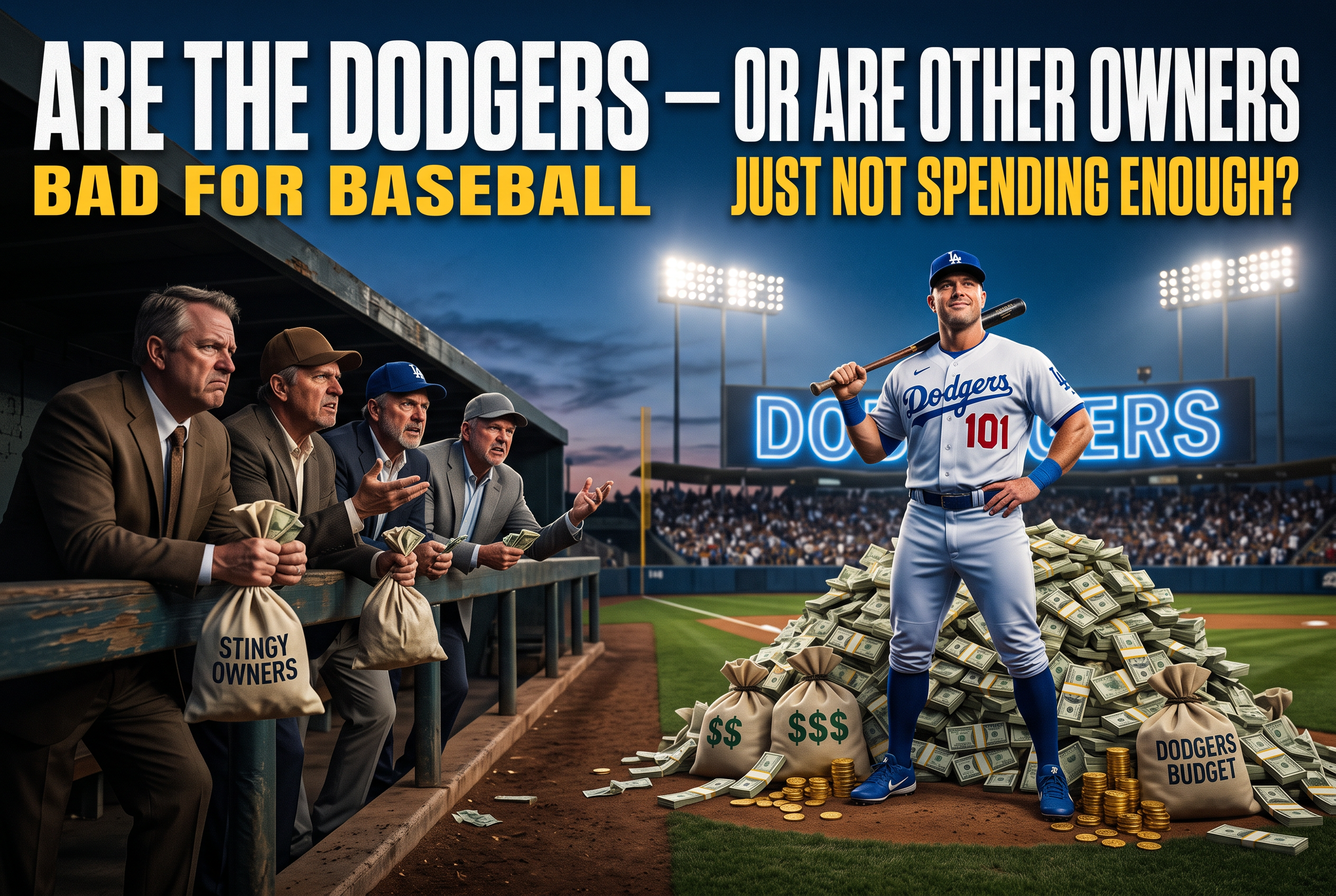
If you've been following baseball lately, you've probably heard the argument:
“The Dodgers are ruining baseball.”
The complaint is pretty simple. Los Angeles keeps finding ways to acquire elite talent while other teams watch from the sidelines. The Dodgers have built a roster loaded with stars, spent aggressively in free agency, and shown that they are willing to write enormous checks to get the players they want.
In 2026, that spending has reached another level. MLB's own analysis noted that the Dodgers' 2025 payroll, including Competitive Balance Tax payments, reached about $515 million, while their 2026 payroll remains comfortably at the top of the league.
And now fans are asking:
Is this good for baseball?
That's where things get interesting.
THE DODGERS HAVE BECOME BASEBALL'S “FINAL BOSS” 💀
There's something intimidating about being a free agent and knowing that the Dodgers are always lurking.
Need a superstar?
The Dodgers might want him.
Need an ace?
The Dodgers might want him.
Need an elite closer?
The Dodgers probably have his agent on speed dial.
Their recent spending spree has included enormous contracts for players such as Shohei Ohtani, Mookie Betts, Blake Snell, and Kyle Tucker, among others. Tucker's four-year, $240 million deal with Los Angeles set a record for average annual value at the time.
The result is a team that can feel less like a normal baseball roster and more like somebody created a fantasy team and then discovered there was no salary cap.
And that's why some fans are frustrated.
BUT HERE'S THE PART WE HAVE TO TALK ABOUT…
Why are we blaming the Dodgers for spending money that MLB allows them to spend?
That's the uncomfortable question.
If the rules allow a team to spend aggressively, acquire talent, develop players, trade for stars and pay the Competitive Balance Tax, then the Dodgers aren't exactly breaking the rules by doing it.
They're playing the game that's in front of them.
And they're playing it extremely well.
MLB's own competitive-balance analysis points out that the Dodgers aren't simply spending—they've also built an organization capable of developing talent, making trades and turning financial resources into sustained success. From 1998 through 2025, Los Angeles ranked second in total payroll and second in winning percentage.
That's not just a checkbook.
That's an organization.
@iamjorgeruiz Are the Los Angeles Dodgers destroying competitive balance in MLB? 💰⚾️ #Dodgers #MLB ♬ Suspenseful and tense orchestra(1318015) - SoLaTiDo
SO WHAT ARE THE OTHER OWNERS WAITING FOR? 💰
This is where the conversation gets uncomfortable for baseball owners.
If you own a Major League Baseball team, you are not running a lemonade stand.
You're operating a professional sports franchise worth potentially billions of dollars.
If fans are buying tickets, jerseys, food, streaming subscriptions and merchandise, they have every right to ask:
“How much of that money are you putting back into the team?”
It's easy to complain that the Dodgers have too much talent.
It's harder to explain why your team can't—or won't—compete financially.
MLB has a real payroll disparity. The league reported that the gap between the highest and lowest payrolls in 2025 was roughly $446 million, a seven-to-one difference.
That is a legitimate competitive-balance problem.
But there's an important distinction:
Competitive balance doesn't necessarily mean forcing the Dodgers to spend less.
It can also mean encouraging everyone else to spend more.
“PAY UP!” SHOULD BE THE MESSAGE
If you're an owner and you believe the Dodgers are ruining baseball because they're signing all the best players, here's a wild idea:
Go sign some of the best players yourself.
You don't like that the Dodgers have an elite rotation?
Build one.
You don't like that they have superstar hitters?
Sign one.
You don't like that they have tremendous depth?
Invest in player development.
You don't like that they keep winning?
Make your organization better.
Because the answer can't simply be:
“The Dodgers are spending too much. Make them stop.”
At some point, baseball has to ask whether the problem is that Los Angeles spends too much—or whether too many teams spend too little.
BUT THERE IS A LEGITIMATE ARGUMENT AGAINST THE DODGERS
Let's be fair.
There is a legitimate concern when one organization has significantly more financial flexibility than most of its competition.
MLB's current labor negotiations are already heavily focused on competitive balance, with owners pushing for economic changes and the possibility of a future salary cap being part of the broader debate.
And if the same handful of wealthy teams can consistently collect the majority of the game's biggest stars, fans in smaller markets can eventually become frustrated.
Imagine being a fan of a team that spends years developing a superstar…
Only to watch him eventually leave because your team can't—or won't—match the offer.
That's a problem.
But again, there's another side.
You don't solve that problem by punishing the team that is willing to pay.
You solve it by fixing the economics of the entire league.
THE DODGERS DIDN'T INVENT SPENDING
Let's also stop pretending Los Angeles invented the concept of buying talent.
The Yankees have historically been one of baseball's biggest spenders. In fact, MLB's own numbers show that from 1998 through 2025, the Yankees spent more on payroll overall than any other team.
The Mets have spent enormous amounts of money.
The Phillies spend.
The Padres have spent.
The Red Sox have spent.
The Cubs have spent.
The difference is that the Dodgers have been better at turning their resources into sustained success.
And that's what makes them so dangerous.
It's not simply:
Money + Players = Championships.
If it were that easy, the highest payroll would win the World Series every single year.
It doesn't.
THE REAL QUESTION FOR BASEBALL ⚾
Maybe the conversation shouldn't be:
“How do we stop the Dodgers?”
Maybe it should be:
“How do we make it possible for more teams to compete with them?”
Give smaller-market teams better revenue opportunities.
Improve revenue sharing where necessary.
Create meaningful incentives for owners to invest.
Consider a salary floor if a salary cap is ever introduced.
And most importantly:
Make owners prove they're actually trying to win.
Because a salary cap without a meaningful salary floor could simply become another excuse for teams to spend less.
And that's not competitive balance.
That's competitive stagnation.
LET THE DODGERS SPEND 💰
Here's the unpopular opinion:
I don't hate the Dodgers for spending money.
I hate the idea that baseball might respond to their spending by telling everyone else they can't spend as much.
If the Dodgers want to spend $300 million, $400 million or more trying to build a championship roster—and they're willing to pay the penalties associated with it—let them.
Then challenge the other 29 teams:
What are YOU willing to spend?
Because baseball fans don't want owners complaining about the Dodgers while sitting on billions of dollars and putting a mediocre product on the field.
Fans want stars.
They want rivalries.
They want meaningful games.
They want their team to actually have a chance.
So if you're an owner looking at the Dodgers and thinking:
“They're ruining baseball.”
Maybe look in the mirror first.
Because the Dodgers aren't the only team with money.
They're just one of the teams willing to spend it.
And if you want to beat the final boss…
PAY UP. 💰⚾